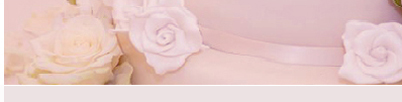
Wedding cakes have been part of the
marriage ceremony ever since medieval times.
Originally
they were made of wheat which was a symbol of fertility
and prosperity. As a relic of once performed fertility
rites, these 'wedding cakes' would have been thrown at
the bride.
Around 1900 years ago the Romans began baking wheat and
salt into small cakes to be eaten. During the ceremony
the groom would eat part of a loaf of this barley bread
and then he would break the rest over his bride's head.
This was taken as a sign of good fortune and a blessing
for long life and many children.
The guests would try
and obtain a crumb for themselves as they too believed
they would then share in the good fortune and future
prosperity of the couple.
As the wedding cake evolved into the larger, modern
version, it became physically impractical to properly
break the cake over the bride's head. The tradition
disappeared fairly quickly in some places, though there
were still reports in Scotland, as late as the 19th
century, of breaking an oatcake over the bride's head.
In Medieval England, wedding cakes were described as
breads which were flour-based foods without sweetening.
The breads were included in many celebratory feasts of
the day, not just at weddings.
No accounts tell of a
special type of wedding cake appearing at wedding
ceremonies. There are, however, stories of a custom
involving stacking small buns in a large pile in front
of the newlyweds. Stacked as high as possible the idea
was to to make it difficult for the newlyweds to kiss
one another over the top. If the bride and groom were
able to kiss over the tall stack, it was thought to
symbolize a lifetime of prosperity.
Eventually, the idea
of stacking them neatly and frosting them together was
adopted as a more convenient option.
It is told that later in the 1660's during the reign of
King Charles II, a French chef (whose name,
unfortunately, is now lost) visited London and was
appalled at the cake-piling ritual. The chef, who was
travelling through England at the time noticed the
inconvenience of piling smaller cakes into a mound and
conceived the idea of constructing them into a solid
stacked system.
In later
years, sugar was added to improve the taste of the lard
and allowed the lard to be left on the wedding cake as a
decorative icing.
The wedding cake took yet another course correction when
in the 17th Century a popular dish for weddings became
the Bride's Pie. The pie was filled with sweet breads, a
mince pie, or may have been merely a simple mutton pie.
A main 'ingredient' was a glass ring. An old adage
claimed that the lady who found the ring would be the
next to be married.
Bride's pies were by no means
universally found at weddings, but there are accounts of
these pies being made into the main centrepiece at less
affluent ceremonies. The name Bride cakes emphasized
that the bride was the focal point of the wedding. Many
other objects also were given the prefix of bride, such
as the bride bed, bridegroom and bridesmaid.
By the late
19th century, wedding cakes became really popular, and
the use of the bride pie disappeared.
Early cakes were simple single-tiered plum cakes, with
some variations. There was also an unusual notion of
sleeping with a piece of wedding cake underneath one's
pillow which dates back as far as the 17th century and
quite probably forms the basis for the tradition of
giving cake as a gift. Legend has it that sleepers will
dream of their future spouses if a piece of wedding cake
is under their pillow.
In the late 18th century this
notion led to the curious tradition in which brides
would pass tiny crumbs of wedding cake through their
rings and then distribute them to guests who could, in
turn, place them under their pillows. The custom was
curtailed when brides began to get superstitious about
taking their rings off after the ceremony.
White wedding cakes...
In the minds of most people, wedding cakes are supposed
to be white. The symbolism attached to the colour white,
makes explaining this tradition rather simple. White has
always denoted purity, and it relates to white wedding
cake icing that first appeared in Victorian times.
Another way in which a white wedding cake relates to the
symbol of purity, has its basis in the fact that the
wedding cake was originally referred to as the bride's
cake. This not only highlighted the bride as the central
figure of the wedding, but also created a visual link
between the bride and the cake.
Today, that link is
being further strengthened as more contemporary brides
have contemporary wedding cakes co-ordinated with their
wedding gown colour, even if it's not white!
Previous to
Victorian times, most wedding cakes were also white, but
not because of the symbolism. Ingredients were very
difficult to come by, especially those required for
icing. White icing required the use of only the finest
refined sugar, so the whiter the cake, the more affluent
the families appeared. A white wedding cake became an
outward symbol of affluence.
Cutting the wedding cake...
Wedding cakes take centre stage in the traditional cake
cutting ceremony, symbolically the first task that bride
and groom perform jointly as husband and wife.
This is
one tradition that most of us have witnessed many times.
The first piece of wedding cake is cut by the bride with
the "help" of the groom. This task originally was
delegated exclusively to the bride. It was she who cut
the wedding cake for sharing with her guests.
Distributing pieces of wedding cake to one's guests is a
part of that tradition from the Roman Empire when guests
clamoured for the crumbs. But, as numbers of wedding
party guests grew, so did the size of the wedding cake,
making the distribution process impossible for the bride
to undertake on her own.
Wedding cake cutting became
more difficult with early multi-tiered cakes, because
the icing had to be hard enough to support the wedding
cake's own weight.
This made cutting the wedding cake a
joint project. After the cake cutting ceremony, the
couple proceed to feed one other from first slice. This
provides another lovely piece of symbolism, the mutual
commitment of bride and groom to provide for one
another.
Multi tiered wedding cakes...
The once simple wedding cake has evolved into what today
is a multi-tiered extravaganza.
The multi-tiered wedding
cake was originally reserved for English royalty. Even
for the nobility, the first multi-tiered wedding cakes
were real in appearance only. Their upper layers were
mock-ups made of spun sugar. Once the problem of
preventing the upper layers from collapsing into the
lower layers was solved, a real multi-tiered wedding
cake could be created.
Pillars as decoration existed
long before multi-tiered wedding cakes appeared, so it
was a natural progression for cake bakers to try using
pillars as a way to support the upper tiers. To prevent
the pillars from sinking into the bottom tier, icing was
hardened to provided the necessary support.
There are
some brides today who can't resist saving the top layer
of her multi-tiered cake. Couples freeze the wedding
cake with the intention of sharing it on their first
wedding anniversary.
The tradition has its roots in the
late 19th century when grand cakes were baked for
christenings. It was assumed that the christening would
occur soon after the wedding ceremony, so the two
ceremonies were often linked, as were the cakes.
With
modern wedding cakes becoming more and more fancy and
elaborate, the christening cake quickly took a back seat
to the wedding cake. When three-tiered cakes became
popular, the top tier was often left over. A subsequent
christening provided a perfect opportunity to finish the
wedding cake.
Couples could then logically rationalize
the need for three tiers- the bottom tier for the
reception, the middle tier for distributing and the top
for the christening.
As the time between the weddings
and the christenings widened, the two events became
disassociated and the reason for saving the top tier of
the wedding cake changed.
Regardless of the underlying
reason, when the couple finally does eat the top tier,
it serves as a very pleasant reminder of their very
special day. |